



Marley Maharrey
is an actor, director, and former middle school teacher. She is co-founder of West of Shake Rag, an improv troupe based in Tupelo. Marley currently teaches with Creativity First Lab, Olive Tree Book Club, and serves on the board of Mississippi Thespians.
In this article, Teaching Artist Marley Maharrey explores how improvisation brings 21st-century learning skills to life in the classroom. Through unscripted performance, students practice creativity, collaboration, communication, and adaptability while building confidence and leadership.
These 21st Century Learning Skills are used when performing improvisation:
LEARNING AND INNOVATION SKILLS
Learning and innovation skills are what separate students who are prepared for increasingly complex life and work environments in today’s world and those who are not. These skills include:
Creativity and Innovation
Critical Thinking and Problem Solving
Communication
Collaboration
LIFE AND CAREER SKILLS
Today’s students need to develop thinking skills, content knowledge, and social and emotional competencies to navigate complex life and work environments. Partnership for 21st Century Learning’s essential Life and Career Skills include:
Flexibility and Adaptability
Initiative and Self-Direction
Social and Cross-Cultural Skills
Productivity and Accountability
Leadership and Responsibility
How They Are Used
Improvisation is an acting method in which actors or “players” perform scenes without a script. Many improvisers start out learning what is called “short-form” improv. Similar to a game, instructions are provided to guide the players in creating characters, a setting, and short plot. Students of all ages enjoy this type of improv because it encourages their creativity while establishing a sense of flexibility. Instead of using a game, a teacher might have students create short scenes with no provided instructions. This allows the children to use collaboration as well as self-direction to engage an audience. I use both methods in a great many of my arts-integrated lessons because they smoothly integrate 21st Century Learning Skills from the Partnership for 21st Century Learning.
A 21st Century Learning Skill in improvisation is productivity. When performing either a game or short situation, you have to produce the movements and/or dialogue to establish a plot. You also accept equal responsibility with your fellow “players” onstage. If you hesitate or don’t stay focused on the scene, your audience will feed off your energy and become disinterested. Since there isn’t a script, the accountability is completely on those performing.
I have heard from students and teachers that the most difficult 21st Century Learning Skills to use within improvisation are collaboration and adaptability. There are no scripts in improv; you have to actively listen, a cross-cultural skill, to your partners and go with the flow. You may have heard the phrase “Yes, and” in different shows, movies, books, etc. This is an improv term. We use it as a motto to keep the scene moving. For example, your partner begins the scene saying, “I heard our boss Mr. Dinosaur is going to give us a promotion today.” You respond using the information you’ve been given (the yes, I got the info you gave me) and add your own new, beneficial information. “I think Mr. Dinosaur might give me the promotion. I’m working hard on these files for a raise!” Do not use anything like, “What? We don’t work for a dinosaur. We are students without jobs.” Giving contradictory dialogue tells your partner their creativity wasn’t good enough and stops the scene’s progress. Confirming and communicating with your partners grows social skills. You are telling them you support their innovative ideas and they can trust you to take the initiative.
Have you heard about the Teaching Artist Collaborative?
This community of artists is committed to supporting other artists and sharing knowledge and resources in arts integration. View the WORKSHOP SCHEDULE to see when the next meeting will occur and connect with other curious artists…..just like you!
While teaching students a game, I work to very clearly give the instructions each time it is played. However, I change the delivery once I know the students understand the format. Rather than directly instructing them, I turn to the audience and explain to keep them engaged, like a show host. After I host a couple of rounds, I ask if a student would like to replace me. Without fail, an ambitious child volunteers. It’s a great opportunity for a student to display leadership in a fun, active environment.
Not everything goes smoothly in every improvised game or scene. Just like a student who is worried about drawing because the lines might not be perfectly straight, there will be a kid who is hesitant to improvise. You are creating entertainment with only a little direction, and you are in front of an audience during your whole process! (I always remind them that they are so brave for doing this in front of their class; there are even adults who are scared of public speaking!) Similar to ability grouping, I recommend having one of those leaders grouped with an unsure actor. The leader can provide the dialogue or movement for the other to “Yes, and.” A game I often play with students is called “L.C.I.” (Location, Career, Injury). It’s a combination of the games Charades and Telephone. It involves no dialogue, but the players must use nonverbal communication, another cross-cultural skill, to share the suggested answers to the next student until they have a guess. What happens if the actor’s physicality doesn’t give enough information for an absolute answer? We problem solve! We go with our best guess and yes, and our way to keep the fun going. The student has to critically think about how they can convey their guess with detailed movements for the next player.
I started doing improvisation while a 20-year-old education student. It brought me new friends, confidence, and skills. Learning how to think on my feet with initiative, listening to my peers, and adapting to different situations, no matter how silly, absolutely helped me in starting my career in the classroom. Through my work with Mississippi Whole Schools, I look forward to sharing the fun with classes all over the state.
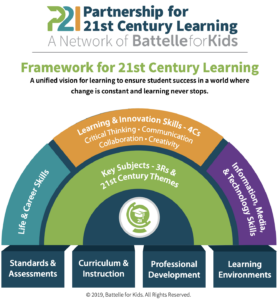
P21 Framework Brief developed by the partnership for 21st Century Learning (now managed by Battelle for Kids)