

Antoinette Badenhorst
traces her understanding of arts integration, from early experiences with traditional art instruction to discovering more meaningful, connected approaches to learning. Through her work at schools, she highlights how combining art forms with academic content creates deeper engagement and lasting impact for students. Her story illustrates the shift from isolated art activities to intentional, integrated learning.
Bringing a School Together through Arts Integration
Antoinette Badenhorst traces her understanding of arts integration, from early experiences with traditional art instruction to discovering more meaningful, connected approaches to learning. Through her work in schools, she highlights how combining art forms with academic content creates deeper engagement and lasting impact for students. Her story illustrates the shift from isolated art activities to intentional, integrated learning.
For many years teachers relied on traditional teaching in which they delivered content and students learned through repetition and cognitive ability.
Art experiences offered opportunities for students to build skills and express themselves. I was often hired by schools to introduce pottery to students. My services were somewhat ineffective because I had to address too many students at a time. I do not believe that the value of these art experiences was of permanent value. There were too many kids involved to give them an authentic opportunity.
Pierce Street Elementary School in Tupelo was one of the few schools where I taught and where I saw the first signs of arts integration. Students learned about the haiku and then made kimonos. By doing so, we did an art activity creating kimonos from clay. They then connected it to the haiku, a Japanese form of poetry, and wrote simple poems to bring it all together. I remember repeating the project with teachers at St Jacobs Camp in Utica, Mississippi sometime later as a professional development activity.
Since then, more schools have adopted the idea of art as a core academic subject and a crucial component for child growth and development. By 2018 more than half the states in the country used arts as a teaching tool. Arts integration breaks away from traditional education. It is an inclusive way to merge arts discipline and class content. This approach to teaching offers opportunities for students to build skills and understanding of class subjects. Making art is a way to express a class subject. In the process both art and subject evolve beyond the classroom, allowing students to expand their knowledge from the original lesson into broader experiences and their personal life experiences. With arts integration in the classroom, teachers can use formative assessment to not only catch issues with students promptly, but to use it as a tool to encourage student innovation and creativity and to help build the future workforce.

Artistic mediums in the classroom
The most accessible forms of art come in the form of writing, drawing, painting, cutting and pasting either with paper or on a tablet, processing found objects, singing, theatre, and so forth. It is often considered to be the most essential exposure for kids. Without these art forms, many students may be completely deprived of art exposure.
Growing up in Southern Africa also laid my foundation. Pottery came much later in my life, and it took a while for me to see the full implications of my interest in clay. As my knowledge and experiences developed, I began to realize that all students should have access to clay regularly.
Sculpting with pottery clay is messy, and without some instruction, success is limited. There is however a huge underlying benefit from just squishing, pinching, and rolling clay around and getting dirty! Apart from the liberating and calming effects, the tactile qualities of clay help to develop motor and sensory skills in young students.
The general belief is that a studio and kilns are required. Therefore teachers apply other resources; painting found objects like rocks and carton boxes to develop their spatial environment. Dance and theatre are moldable forms of art in which people not only create content, but their bodies are flexible objects that explore their 3-dimensional surroundings while delivering new content all the time. These are excellent ways to teach, but cannot replace forming malleable clay. Children intuitively want to touch it, press it, and roll it, despite some students who still need to develop their sensory skills and need time to get used to the texture of clay.
Listen as Antoinette shares her statement of practice.
Paperclay is a solution in the classroom.
Over the years teachers used paper machè and/or self-drying clay or other artificial types of clay to create 3-dimensional objects in the classroom. Each one of these mediums has its challenges. Teachers often expressed their frustration with artificial clays, especially self-drying clay, which I am so often asked about.
Paperclay is real pottery clay which becomes by the day more popular among potters. It offers a solution for a user friendly and cheap medium in the classroom, is recyclable, and is simple to work with since it does not have the normal requirements of regular pottery clay. It can be finished and fired in a pottery kiln like regular clay or left unfired and finished with acrylic paints. Creating with real clay is not only a relaxing activity, but it has many benefits that will assist students in developing motor and sensory skills. Gaining control over clay and connecting it with a class subject opens cognitive receptiveness and a deeper understanding of problem-solving skills. Students can fully differentiate their communicative expression by bringing the clay medium, art discipline, and class subjects together.
During a recent residency, the objective was to teach students and their teachers the basics of sculpting with paperclay. We incorporated science (oviparous), math (understand the relationship between numbers and quantities; connect counting to cardinality), and ELA (The Little Red Hen by Paul Galdone, Barnyard Song by Rhonda Gowler Greene) with pottery. With the limited time we had available, I chose to highlight the responses and connections from the visual art core standards. My lesson plan involved LK2.4, RLK.2, K.CC.5 & Cn10.1.K, and Cn11.1.K from the core standards.
The Little Red Hen
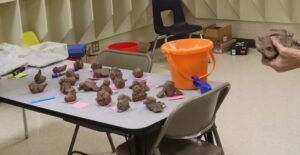
We successfully created eggs during the first part of the residency in November. All the kindergarten students and their teachers spent an average of 45 minutes in the project room. They were well-engaged in the process. With the focus on “The Little Red Hen,” we succeeded in integrating vocabulary, emphasizing the storyline, and finding connections to all the various subjects, including art.
We discussed the word “oviparous” and decided which animals fit the description. We had to stop for the holiday break and resumed the rest of the project in January.
These students were eager to work with me and we successfully enforced the moral of the story: “If you help with sweeping the floor, planting the wheat, hoeing the weeds, harvesting and grinding the wheat, and baking the bread, then you can help eating it too”. They helped with what most children love doing: Play with water! They washed the tables while I had to make sure they did not use too much water to make a mess! The beauty was that they could conclude the moral of the story with something easily doable, which they could connect to, and which was fun.
Snowy Owl and Polar Bears
In January the kindergarten students moved beyond the Little Red Hen toward learning about habitat. With some shifts in the planning, the school decided to bring first-grade students in to learn about landforms and 2nd graders learning about arctic animals.
I was challenged with all this new information one week before I had to be at the school. It was around the beginning of January when everybody had to pick up the reigns again, so I had to go above and beyond to obtain the right resource materials. The teachers could provide me with the MS CCRS, but it was harder to obtain the resources which corresponded with their scope and sequence.

Solving the problem with Arts Integration
There is a saying, “Use a crisis to your benefit.” The crisis came in the form of an ice storm, which do not happen often in Mississippi. We ended up working with 3 grades and a group of teachers who needed professional development with all the new subject matter that I received a week before the residency. Losing 2 days of the residency because of the weather, left us with 2 days to complete the full process of integrating art with class subjects and working with teachers on PD! Using my original lesson plan, we added core standards from 1st and 2nd grade, and additional resource material that I found in interesting places.
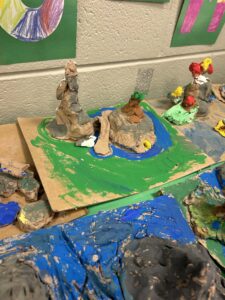
One of the most important aspects of being an artist is to find solutions to problems and to never panic when working with students. Fortunately, my experiences helped me through this. There was no time to re-firm class content with teachers, so I had to go with some research I did and bring it together with clay as a sculpting tool. The common denominator with these 3 grades was the landforms, which offer habitat for The Little Red Hen, Snowy Owl, and Polar Bears. Therefore I could let the first graders do their landforms while we casually mentioned the Arctic Circle where snowy owls and polar bears found their habitat. I addressed habitat to the Kindergarten group. Chickens and snowy owls live in different parts of the world. We discussed the features of each so that the students understood why animal features make them suitable to live in certain areas. This helped them to apply these features to their chosen animals.
With the 2nd graders, we compared the polar bear and the snowy owl, emphasizing the features of each that made it possible for them to survive in their habitat. These descriptions were all processed and planned for their sculptures.
We succeeded in executing the art projects and learned vocabulary from all the various subjects, including art. Some students could comment on their projects, allowing us to use anchor standards to respond and connect with their experiences.
While the first part of my residency was more of an art experience and the second part ended up in only 2 days, I could not spend enough time on a well-executed art lesson and I could not pay more attention to I-can statements. With an average of less than 2 hours per student, I tried to connect the class subject, core standards, and visual arts as best I could. There was no time to pay attention to the finishing and presentation.
Despite those hiccups, I think the students and teachers did learn enough to make it worthwhile and there may be opportunities for follow-up. If we could fit that amount of detail in such a short time, I would love to see these classes happen under ideal circumstances.
There were on average 6-8 teachers in every classroom while I was working with the students, so I juggled PD with student lessons. I wished I had more time to get to know each one of these teachers better and to build a partnership with them. There was not enough time to communicate with them individually and to work on commitment with them, but despite that, some of them went out of their way to assist with the students.
There will always be situations that are not ideal, but as long as an artist can think on their feet, have the student’s well-being in mind, and have a good partnership with the teachers, the arts integration will only get better for the benefit of our students.