


Kim Gentry
is a dedicated movement educator with over 20 years experience working with children. Kim is passionate about preserving cultural heritage while introducing students to the joy of movement. Her work blends traditional dance with modern movement practices, using the power of movement as a tool for learning, growth, and self-expression.
Empowering Students Through Arts Integration: A Mississippi Whole Schools Experience
Teaching Artist, Kim Gentry, shares her residency experience at Crestwood Elementary in Meridian, Mississippi, highlighting the power of arts integration to deepen student learning. By blending dance, visual arts, math, science, and social-emotional learning, the work brought creativity and academics together in meaningful ways.
I had the incredible opportunity to work with Crestwood Elementary in Meridian, MS, as part of the Mississippi Whole Schools Certification Program. This program, which focuses on integrating the arts into core academic subjects, allowed me to engage with students in a way that fostered both creativity and academic growth. Over the course of my residency, I had the chance to create activities that connected dance, visual arts, math, science, and social-emotional learning (SEL), all while helping students strengthen their academic skills.
Background Information
Crestwood Elementary is a smaller school with a close-knit community. The staff and students were open to new ideas, and many teachers were excited to explore the integration of the arts into their classrooms. The school faced challenges common to smaller schools, such as limited time for enrichment activities and a desire to make learning more engaging for students. They were also open to incorporating SEL into their curriculum, recognizing how important emotional and social development is for student success. This made Crestwood a great fit for arts integration, and I was excited to contribute to their vision.
Goals and Objectives
My goals for the residency were focused on demonstrating the connections between the arts and other academic subjects, such as math, science, and ELA, while also addressing social-emotional learning. I wanted students to understand how subjects that might seem separate could actually work together in creative and meaningful ways.
Lesson Goal/Big Idea: Students would demonstrate an understanding of the connections between dance, language, math, and science by creating and performing movement pieces that incorporate rhythm (mathematical patterns and number comparison), movement vocabulary (ELA), and science-based concepts, all while reflecting on their emotional expression and teamwork skills.
Lesson Objectives:
- Students would understand and apply mathematical patterns by creating a dance routine that incorporates rhythm and movement sequences, demonstrating at least three distinct patterns (e.g., repeated steps, varying tempos).
- Students would use movement vocabulary and descriptive language in their dance presentations to communicate the theme and emotions of their piece.
- Students would explore how animals, like alligators, use their physical features (e.g., scales) to survive in their habitats, and express their understanding through artistic expression.
- Students would collaborate with peers to develop and perform a cohesive movement piece, demonstrating effective teamwork and roles within the group while emphasizing a story sequence (e.g., beginning, middle, end) and using linking words.
- Students would reflect on their emotional expressions and the feelings conveyed through their dance, sharing their insights during class discussions.

Students explore rhythm and pattern through concentric circle art, blending visual arts with math concepts in a creative classroom activity.
Work Done
One of the most memorable activities I introduced was the Alligator Dance Exploration. This project blended science, math, dance, and SEL. Students began by learning about alligators and their physical features, such as their scales, and how these adaptations help them survive. They then created a dance that represented an alligator’s movement, using math concepts like rhythm patterns and tempo changes (e.g., fast and slow). The students also used visual art to create props, such as scale-like materials, to enhance their performances.
This activity helped students better understand mathematical patterns through movement, reinforcing concepts like comparison, sequencing, and rhythm. The use of visual art not only added an element of creativity to the project but also gave students a hands-on opportunity to explore science concepts in a new way. Additionally, students worked together in groups, demonstrating their teamwork skills and learning to collaborate to produce a final performance.
Another fun activity I introduced was Limbo with Purpose. In this game, students took turns going under a limbo stick, but before each student could go under, they had to either say a positive word, solve a math equation, or use a linking word (e.g., “because,” “also”). This simple yet engaging activity allowed students to practice their academic skills while having fun. It was amazing to see how excited they were while waiting their turn, and I noticed how the teachers enjoyed seeing the students so involved and happy.

Young learners use linking words and visual storytelling to build narrative skills and enhance language arts through arts integration.
Outcomes
The outcomes of these activities were incredibly positive. Through the Alligator Dance Exploration, I could see students begin to understand math concepts more clearly. As they practiced their dance routines, they were able to correct themselves and refine their movement patterns, showing a growing mastery of mathematical ideas like rhythm, sequencing, and comparisons. Over time, students began to grasp how to apply these math concepts more effectively.
In terms of social-emotional learning, I observed a noticeable shift in students’ emotional regulation and self-awareness. By the end of the day, students used breathwork techniques to calm themselves and center their emotions, which helped them leave the classroom in a much more calm and focused state. The combination of movement, SEL strategies, and creative expression provided a balanced learning experience that supported students both academically and emotionally.
Additionally, activities like Limbo with Purpose had an immediate and visible impact. Students practiced math and language skills while having fun, and I could see how much they enjoyed the chance to engage with their peers in a playful yet educational way. Teachers also appreciated the excitement it brought to the classroom, and it was rewarding to see the students so motivated and positive.
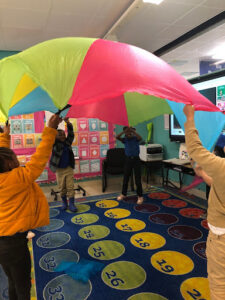
Students engage in collaborative storytelling using a parachute, combining movement, teamwork, and social-emotional learning in an interactive lesson.
Reflections
Reflecting on my time at Crestwood, I was deeply impressed by the dedication of the teachers and staff. They work incredibly hard to ensure that each school day runs smoothly and that every student’s needs are met. It was inspiring to see how much they care about the success of their students, both academically and personally.
During a professional development session, many teachers expressed a desire for more time to focus on classroom activities, yet they all emphasized the importance of SEL for student success. This reinforced how crucial it is to balance academic rigor with emotional development.
I also felt significant professional growth, particularly in terms of communication with staff members and students. I learned a lot about how different students learn and how important it is to respect those differences. The experience reinforced my commitment to always remain open to different learning styles and to adapt my teaching methods accordingly.
One of the most rewarding aspects of my time at Crestwood was seeing how engaged and happy the students were. Most were excited to participate, and it was uplifting to witness their joy in learning. This experience made me even more committed to using creative and interactive methods in my teaching practice.
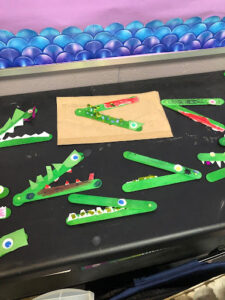
Handmade alligator-inspired props help students embody science concepts through dance and art, showcasing a dynamic arts-integrated learning experience.
Conclusion
In conclusion, my experience at Crestwood Elementary through the Mississippi Whole Schools Certification Program was truly transformative. The integration of arts into academics not only helped students understand subjects like math and science in new and creative ways but also nurtured their emotional and social growth. The Mississippi Whole Schools program is essential for the future of arts integration, providing a framework that supports students in becoming well-rounded, creative, and resilient individuals. As we move forward, arts integration will continue to play a vital role in ensuring that students are prepared to thrive in a rapidly changing world.