
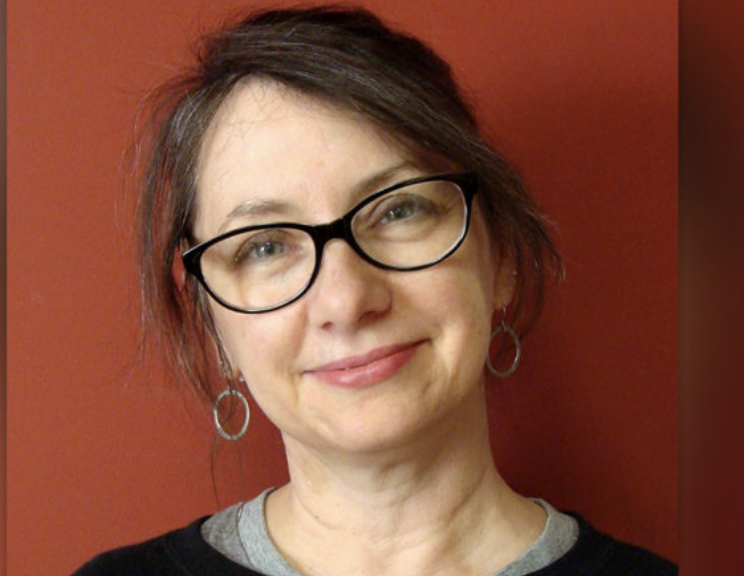
Angi Cooper
is a certified teaching artist on the Mississippi Arts Commission Teaching Artist Roster.
Evolving, Always Evolving
Angi Cooper has been a visual arts teaching artist for nearly two decades, but her two week TACP residency at Thomas Street Elementary pushed her in the best way. In this reflection, she shares what it looked like to plan with real clarity, connect an ELA standard to both story and science, and stay flexile when second graders hit her with the classic “I can’t draw.” If you are trying to make standards feel workable without squashing the art, Angi’s “evolving, always evolving” approach will feel very familiar.
A New Adventure
In the summer of 2024, I was accepted into the Teaching Artist Certification Program (TACP) through the Mississippi Arts Commission. I have been working as a visual arts teaching artist (TA) for about two decades, but this program has been such a profound professional experience to add to my TA arts-integration repertoire.
Part of the program requirements included conducting a 2-week residency in a Mississippi Whole School. My residency was with 2nd grade students at Thomas Street Elementary in Tupelo.
Meeting With the School
During the fall TACP training in Meridian, I met with Thomas Street art specialist Rachel Davis to find out more about Thomas Street, what the school’s needs were, and to create a residency schedule. I have had many in-person meetings with classroom instructors before, but the meeting outline template that the TACP program provided made sure no stone was left unturned! Using this thorough outline helped me get a detailed grasp on how to prepare for what Thomas Street 2nd graders needed, which was help in understanding the bigger picture of a story or the big idea of informational text. Our residency focus was a Language Arts standard where students were to demonstrate an understanding of key details and describe relevant subject matter. Dear Primo: A Letter to My Cousin, the book by Duncan Tonatiuh, was the curricula for week one and volcanoes was the subject for week two.
Designing A Residency
At first, it seemed challenging to make the switch from literature to science using the ELA standard. Discussing this challenge with my fellow certification participants on our weekly Zoom meeting certainly helped. Ideas were suggested for possible activities, including working with clay for volcanoes. And then while doing a bit of research on volcanoes, I happened upon the legend of the Aztec princess and warrior volcanoes in Central Mexico. That was it. It all clicked—the book about the American and Mexican cousins, volcanoes in both the United States and Mexico, and the mythological story behind two of the volcanoes. Yes, this was going to work!
My plan was for students to create artwork related to the characters and situations in the storybook as it related to the book’s overall idea–that we are more alike than different—and to segue the idea of having a cousin/friend (real or imaginary) in Mexico into a letter writing activity. One of the questions they were to ask the cousin was if they lived near a volcano or earthquake zone. This would provide the blending into the informational text portion of the residency where we would study volcano information and create both 2-D and 3-D volcano art.
Week One
In week one, using the situations from the Dear Primo story, I introduced the students to works of art by other artists similar in theme to the activities illustrated in the book. Students worked with different media and different art-making processes for creating their work.
Having such a cool book like Dear Primo to work with was truly wonderful when designing the week’s activities. There were interesting aspects within the book illustrations that lent some nice pivots into their art-making. For example, all of the people depicted in Dear Primo were in profile and many of the pages had a certain color palette or limited use of color. The two cousins were often shown playing games with their friends.
I used the artwork Two Builders Playing Chess by Jacob Lawrence to make connections to those elements and have the students observe and analyze. Both people in the painting are in profile and the color palette consists of 6 colors, which worked well for this lesson as a lot of the imagery in the book was flat in both shape and color. After a small warm-up of cutting and tearing paper, students chose 5-6 different colors of paper to cut or tear for creating their art: an image of two people playing a game, which could be a board/card game or outside game. They were to also describe what was happening in their artwork in one sentence.
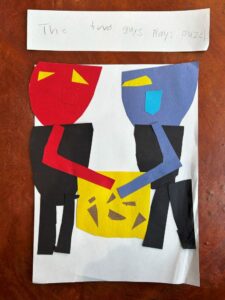
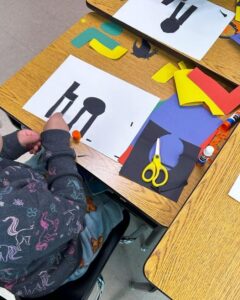
Photo on left: Student artwork inspired by Two Builders Playing Chess by Jacob Lawrence using cut paper in limited palette. The sentence describes the activity: The two guys play puzzle.
Photo on right: Students working on this activity at their desks using paper, scissors, and glue sticks.
Other activities during week one included: ‘waking up’ self-portrait drawings, drawings with several figures performing an activity, paper quilt square construction for a group class quilt, and letter writing to the friend/cousin from Mexico.
Learn more about the Teaching Artist Certification Program
Week Two
Three-dimensional art was introduced during week two–working with clay to create 3-D volcano forms. Students chose from shield, cinder cone or stratovolcano for creating their shape. Working with the clay was a fantastic connection to this incredible earth form and was a new experience for quite a few of the students.
For our two-dimensional work, students used volcano information sheets I created to draw a sketch of a volcano. On this sketch, they were also to include a title and at least one piece of information off of the information sheet. This sketch would be the ‘working’ sketch for their final volcano poster to be created on 12 x 18” construction paper. Students used darker colored paper for a night sky and lighter colored paper for daytime skies. They also used oil pastels and cut or torn paper for illustrating their volcano, title, and information resulting in a culminating artwork highlighting what they have learned about volcanoes and using that knowledge for creating their ‘big picture’.
The final day of the residency included arrangement of the previous week’s paper quilt squares onto brightly colored bulletin board paper for the paper quilts which the teachers displayed in the hallway. Students put the final touch on their volcano posters and presented their work to the class. We ended with a Pompeii exhibit slide show from the Pompeii exhibition I viewed in Memphis, an extra special treat that tied in with our volcano studies and seeing how we have aspects in common (our book’s main idea!) with Roman culture including graffiti and to-go food!
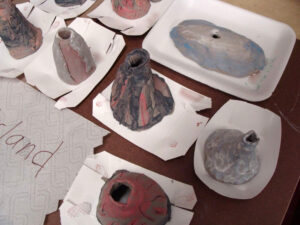
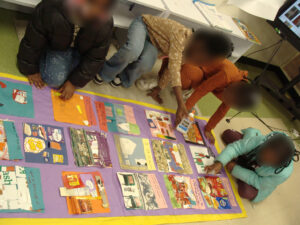
Photo on left: Students created 3D clay volcano forms.
Photo on right: Students arranging their art designs to create a paper quilt for hallway display.
Afternoon Printmaking Sessions
During both weeks, I also had the opportunity to work with art specialist Rachel Davis with 2nd grade in printmaking. We used some of the shape and line work skills in creating a relief plate for block printing. I enjoy working with different art instructors and seeing their approach. Ms. Davis used ambient lighting in the art classroom and work stations where groups of students would sit. Art supplies were well organized and there was plenty to work with. Using the projector board for brief videos and drawing demonstrations were helpful tools. It was also great to see how she used different materials and techniques in the printmaking process giving me some new choices for future classes. I love seeing how other art instructors use materials.
Reflecting Back
This was probably the most intense artist-in-residence experience I’ve had in quite some time. It was a profoundly exciting and rich opportunity to do a deep dive into the curricula with two 2nd grade classes and helping them use visual art as a way to strengthen their understanding. I was a bit nervous before the first week, but truly, the factor that helped me the most was being open to what presented itself in the classroom. When giving the drawing assignment, I did receive quite a few “I can’t draw” and “I can’t do that”. So, I met them where they were. I took my marker and used lines and shapes to create stick figures on the board. Everybody participated, some had natural drawing skills, others used stick figures, and even one student who was notorious for not participating (and my strongest “I can’t” person) actually created a drawing!
The students were open to the ideas I presented and there was good focus on completing the activities. Participation is more important to me than artistic skill, so I was happy to see students finish their work and even ask to be able to finish pieces from the previous lesson.
Bringing this residency to life in the classroom had meaningful growth for me both personally and professionally. It reinforced my confidence and gave value to my work as a teaching artist, and it has been a much-needed submersion in working with the standards for building a lesson plan. Working in this curriculum connected process continues to push me in my own thinking and engaging with students, as the Kennedy Center Arts Integration definition says, helping “students engage in a creative process which connects an art form to another subject area and meets evolving objectives in both.” Evolving, always evolving!