



Chris EspinosaXZY
is a Kennedy Center Teaching Artist and a Mississippi Whole Schools Certified Teaching Artist. Integrating the excitement of theatre arts with curriculum standards, his lessons include laughter, zany scenes, and memorable learning experiences.
GASP! Melodramatic Acting Inspires Students
Meet Chris Espinosa, a Young Audiences Nationally Credentialed Teaching Artist and proud graduate of the 2024 Mississippi Arts Commission Teaching Artist Certification Program, who is here to make one thing clear: melodrama is not “silly nonsense,” it is a sneaky, joyful way to get kids writing, thinking, and performing with real purpose. In this post, Chris takes 4th and 5th graders at Laurel Magnet School of the Arts from a single word prompt to full blown scenes, scripts, revisions, and reflections, all while tying Language Arts goals to Theater Arts skills.
(Hand to the forehead, palm facing outward. The following sentence is read with a hint of frustration.) Oh, how can learning to overact(1) prepare students theatrically or academically? This is beneath me – I have standards! State-required standards. (Ba-dum-pum!)
On the surface, the art of melodrama(2) may seem like silly nonsense just for laughs: exaggerated gestures, extreme vocal enunciations, over-the-top expression of emotions, and bad jokes!
Baloney, I declare! Melodrama is more than that. Yes, my lessons are full of melodramatic, zany comedy, but I am serious about providing authentic art instruction that motivates students to discover their voice as a writer on the page and as a performer on the stage. Students in my residencies are able to interpret Language Arts standards (narrative, expository, or poetry) and develop role-play scenes to demonstrate their understanding of Theater Arts standards (sketch comedy, farce(3), and boo-hiss-yay melodramas(4)).
Certified to Over Dramatize!
Although I was born to overact, I learned how to be a Teaching Artist in real-time, in front of students, and without formal training. Fortunately, in August 2023, I was accepted to the Mississippi Whole Schools Teaching Artist Certification Program (TACP). MS Whole schools created the TACP to provide a way for teaching artists like me to earn certification as an arts integrated teaching artist.
From TACP into a Mississippi Classroom
As part of my TACP training, I was paired with the 4th Grade (Ms. Watts) and 5th Grade (Ms. Sullivan) at Laurel Magnet School of the Arts Elementary to present a two-week, arts integrated residency(5).
According to their website: “Laurel Magnet School of the Arts has been a Mississippi Arts Commission Whole Schools Initiative school since 1999, a Model School for the Arts since 2003, and is an Exemplar Model school in the state. This initiative expands regular classroom instruction to include visual and performing arts as a creative and engaging learning tool across the entire curriculum. The school was recently rated an “A” by the Mississippi Department of Education.” The Mississippi Department of Education assigns A-F accountability ratings to schools annually based on a variety of data measures. Learn more about these ratings.
You can sense Laurel Magnet’s dedication to arts integration when you walk the halls –
Lesson plans and student works are plastered all over the walls. Most of the 4th and 5th graders have attended Laurel Magnet since Kindergarten; they have lived and breathed the arts their whole lives. My gut told me that my time at Laurel Magnet would be like no other experience I ever had as a Teaching Artist. It was right!
ACT 1: The First Week
Setting: 4th grade classroom, Laurel Magnet School of the Arts. First week of a two-week residency.
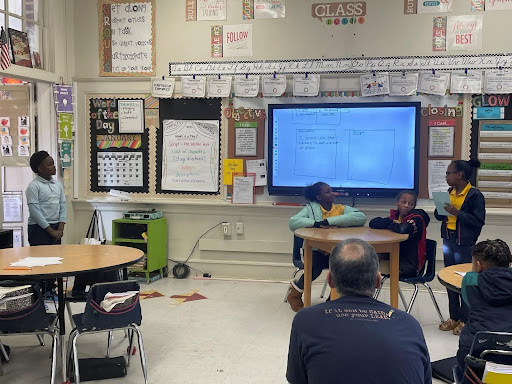
(Pictured) Students perform a scene inspired by the word “kitchen.” As the story unfolds, the audience discovers that there is a problem in the restaurant’s kitchen. (Photo credit: Casey Watts)
Yaaaaay! The Melodramatic Teaching Artist Enters Stage Right
The 4th grade developed an understanding of the narrative through the elements of drama: dialogue, characters, setting, and stage directions. Small groups of students performed scenes based on one word: kitchen (setting). They had only five minutes to collaborate/plan what they were going to say (dialogue) and how they were going to move across the stage (stage directions). Although they had time to plan, most of their performance was improvised, i.e., created in the moment on stage. Students were challenged to create characters as big and over-the-top as they wanted. There were plenty of funny characters, and at times, I laughed so hard that I cried. Each group wrote a script inspired by their scene. They continued to revise and edit their scenes via script writing and performing. (Post Residency: Students continued to work on prose by transforming their scripts, characters, and story arc into a written narrative.)
Whaaaaat?! 4th Grade Students Reflect on Their Process and Make a Responsible Decision About How to Improve Their Work
All but one of the groups created scenes that took place in traditional kitchen settings: at the kitchen table celebrating a surprise birthday party for a pet dog; family members cooking and preparing food for a holiday meal; a restaurant kitchen that couldn’t keep up with the orders; and another restaurant kitchen that burned the food. The groups had the option to choose any location for their setting; One group chose a zoo as their setting.
In the zoo scene, a student was determined to portray a crocodile, complete with a moment of reptile potty humor. During a critique and reflection session, I asked questions for the student to reflect on his choice to be a croc because how he envisioned the scene was not how it was being perceived. He would not change his mind and the others in the group supported his choice. Embodying a crocodile was a bold choice—no other group in either class attempted something so out of the ordinary. This was a perfect example of taking a chance and creating a larger-than-life moment. I applauded them for sticking with their original idea.
After a few rehearsals and some critical thinking, the student realized that the croc had to be changed into a tiger to tell a better story. Ms. Watts was thrilled to see how these students collaborated to resolve their problems on their own.
ACT 2: The Second Week
Setting: 5th grade classroom, Laurel Magnet School of the Arts; Second week of a two-week residency. Something dastardly and cold-hearted was about to make an entrance. Dun-dun-DUN!

(Pictured) Students write a narrative poem inspired by their costume and the character they created. Students performed their poems for the class. (Photo credit: Kiersten Sullivan)
Boooooo! Ice Storm Enters Stage Left and Puts the Residency in a Deep Freeze
My original 5th grade residency lesson plan integrated Shakespeare into the poetry Language Arts standards where students created Shakespearean sonnet(6) through character development, improvisation, and iambic pentameter(7) which is a writing format that uses ten syllables per verse. Unfortunately, Mother Nature unleashed an ice storm upon the South, including Laurel. EGAD! The City of Laurel was iced-in Sunday through Wednesday. That left us with only two days, Thursday and Friday, which was not enough time to experience sonnets properly. I opted to delete Shakespeare and focus on how students’ voice/style of writing (their personal writing rhythm) influenced the rhythm of their original poetry.
Yaaay! The Ice Storm Was No Match Against 5th Graders’ Gusto for Poetry and Performing
The 5th graders electrified the classroom with enthusiasm as they connected their performances to the rhythm of writing. The poems were based on their characters inspired by the Renaissance-style/Shakespearean costumes I provided: a king, a queen, a wizard, a knight, a couple of witches, farmers, and assorted peasants/villagers. I initially purchased these costumes for the Shakespearean lesson plan. However, I decided to use them anyway. Not just because I had already transported the costumes from Texas to Laurel (including my Excalibur-in-Stone prop). I wanted to use them because in my 20+ years as a Teaching Artist, I had never used costumes in any of my residencies. I was curious to see how they would enhance, or possibly interrupt, the students’ experience.
The costumes enhanced the residency experience. Ms. Sullivan was blown away by her students, especially her shy kids; the ones who were reluctant to participate but were now writing and performing in character. She was inspired to create her own arts integrated poetry unit. To make up for the ice storm days, Ms. Sullivan and I want to create a supplemental video lesson.
Awww! My Time at Laurel Magnet School of the Arts Elementary is Over, But…
I’m still excited about what the students accomplished. Given the culture of art at Laurel Magnet, it’s no wonder how well the 4th graders successfully collaborated/developed their role-playing scenes and how the 5th graders created characters and wrote poetry. They were not afraid to be big and silly with their performances. The sheer joy expressed by the students was heart-warming. (Which was nice considering the ice-storm!) I admit that some measure of their happiness was directly connected to their time performing. However, I must add that there was just as much of a sense of pride beaming through because the students were able to accomplish the Language Arts standards THROUGH Theater Arts standards.
No matter how many times I visit schools, I’m still surprised at how the art of melodrama, a silly 19th Century art, can inspire a 21st Century student. I will brag about these students for a long time! This residency is a perfect example to explain how Arts Integration creates the space for students to step out of their comfort zones and onto centerstage. With results like these at Laurel Magnet School of the Arts, how could anyone deny their students the experience of arts integration with the Melodramatic Teaching Artist.
Glossary
- Overact – To perform in an exaggerated manner for comedic purposes.
- Melodrama – A comedic or dramatic performance with exaggerated gestures and unrealistic displays of emotions.
- Farce – A comedic performance; characters are involved in ridiculous situations.
- Boo-hiss-yay Melodrama – This is also a comedic performance with exaggerated gestures, extreme enunciation, and comical displays of unrealistic emotions. The difference between Melodrama and Boo-hiss-yay Melodrama is the reliance of audience participation – a key element! In fact, audience participation is mandatory. The audience is encouraged yell “Boo!” and “Hiss!” when the villain is on stage and to cheer “Yay!” when the hero saves the day. Also, the actors in Boo-hiss-yay Melodrama constantly break the Fourth Wall; they adlib, talk, and engage in banter directly with audience members. (The Fourth Wall is the imaginary wall that separates the actors from the audience. Actors perform without directly engaging with the audience.)
- Arts Integrated Residency – A residency is a presentation for the same group of students, usually one classroom, over a period time that is at least three days; Arts Integration is an APPROACH to TEACHING in which students construct and demonstrate UNDERSTANDING through an ART FORM. Students engage in a CREATIVE PROCESS which CONNECTS an art form and another subject area and meets EVOLVING OBJECTIVES in both. Students must be actively engaged in an art, over a period of time. (The Kennedy Center Arts Integration definition.)
- Sonnet – A fourteen-line poem that is written in iambic pentamer. The author can use any rhyming scheme of their choosing.
- Iambic Pentameter – A line of verse in a poem that is composed of ten syllables. The rhythm alternates between unstressed and stressed syllables, similar to the rhythm of a heartbeat and repeats five times: ba-dum, ba-dum, ba-dum, ba-dum, ba-dum.
Take our Teaching Artist Self-Assessment to help you
identify your best next steps.
Learn more about the Teaching Artist Certification Program