


Sara Doman
is an award-winning elementary art educator in the McComb School District, currently teaching at Kennedy Early Childhood Center and Summit Elementary School. Named the 2022 Mississippi Art Education Association’s Elementary Art Educator of the Year, Sara is passionate about arts integration and creating cross-curricular connections that deepen student learning. A member of the Mississippi Arts Commission’s Teaching Artists Certification Program Class of 2023, she brings creativity, resourcefulness, and a commitment to whole-child education into every lesson. Whether she’s fusing science with visual art or tying in literature through hands-on projects, Sara empowers students to think critically and connect their learning across subjects. She is also an avid gardener and helps support aquaculture efforts on her school’s campus.
My Residency at Laurel Magnet School for the Arts
Teaching Artist Sara Doman shares how collaboration and creativity can elevate both teaching and learning. Laurel Magnet School for the Arts + Resident Artist = Growth for All highlights how visual arts integration deepened student understanding across ELA and math while supporting teachers new to the approach.
For the past several months I have been participating in the Teaching Artist Certification Program that the Mississippi Arts Commission and Mississippi Whole Schools (MSW) has created as a way to foster a stronger Teaching Artist pool. As an Elementary Art Teacher who has been a creative for my entire life, I have loved connecting with like minded people and learning how to strengthen my skills as a teaching artist.
I have also been interested in the Mississippi Whole Schools approach to an Arts Integrated teaching style for several years and this certification program has given me the full picture of how the MWS program operates.
My Residency at Laurel Magnet School for the Arts (LMSA)
I was matched with Laurel Magnet School of the Arts in Laurel, MS. LMSA has seen spectacular results over several years as an arts integrated school. After speaking with the English Language Arts and Math lead teachers, Casey Watts and Andrea Schipke, you know that the high rating they have maintained is a direct result of their dedication to the arts integration teaching style.
After meeting with the lead teachers and digesting some of the trials they were experiencing this year, we felt it would be best to work with their 6th grade teachers, who were new to the arts integration style of teaching. With this information, I felt that I needed to be able to give my partner teachers a glance at how to conduct a full scale arts integration lesson with layers of detail and several connections to the visual arts standards. I was fortunate that the group of scholars I was working with had all been attending LMSA for several years and were primed to get into a full body visual art lesson.
Week 1: Connecting ELA with Banksy and Printmaking
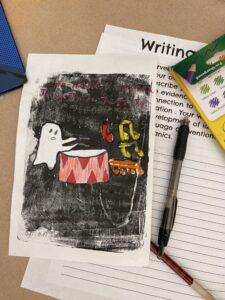
Because the teachers were still learning how to integrate the arts, I wanted to show them what their scholars were capable of. We reviewed the elements of art and the principles of design for our first week in the ELA classroom. We dove deep into the work of Banksy. We connected Banksy’s public art style with metaphors and symbolism. I brought a style of quick printmaking with gelli plates to lay the foundation of our work. We had to work quickly to connect with the way Banksy had to use stencils to create the detailed layers of his anonymous public art.
Once we laid the foundation, we added detail with colored pencils, markers and oil pastels and that made their connection to their metaphor come alive. By the end of the week, with the help of Mrs. Watts, the 6th grade ELA teacher and the district literacy coach, we came up with a writing prompt for the scholars to analyze their own artwork using the elements of art and principles of design in relation to the metaphor they chose.
ELA Teacher Feedback:
The student writing produced during this arts-integrated lesson was the strongest example of the year.
Have you heard about the TEACHING ARTIST COLLABORATIVE?
It’s a group of artists just like you.
Sign up. Attend when you can.
Participate in workshops that are relevant to YOU.
Week 2: Bringing Math to Life with Edward Hopper
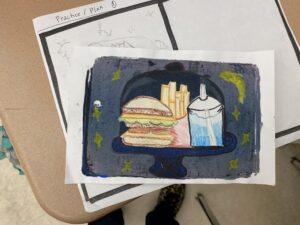
The groundwork we laid with the elements of art and principles of design made my second week in the math class seem like a breeze. We were all speaking the same language and were now communicating about the math and the art in an elevated way. We had a simple concept to cover, but it was a challenge to develop a lesson that could keep our elevated conversations going. Fortunately, we were able to connect the concept of negative and positive numbers on a number line to the painting “Nighthawks” by Edward Hopper.
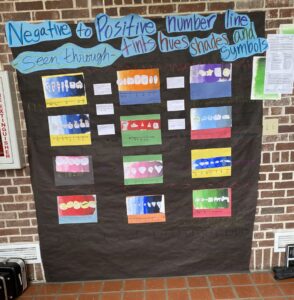
Scholars were able to discuss this painting using the principles of design and apply the elements of art to those specific concepts they were seeing. Once we analyzed the art in this way, they immediately saw the connection to the number line. We then layered two concepts together to engage the negative to positive number line math skill. The monochromatic color scale was their base layer with the tinted side becoming more negative and the shaded side becoming more positive. Scholars then had to choose an emoji as the zero point on the number line and then make two more emojis on either side, which had to indicate that something more negative and more positive happened.
The discussions that evolved from this portion of the process took us back to our ELA lesson when we discussed negative and positive connotations. We were asking questions such as, was your emoji getting the full range of positive and negative or were they showcasing only a positive or negative range. Several scholars had to adjust their emoji designs to fully align the concepts. This step in the process was definitely a moment of reflection and assessment for the math teacher and me. Overall, the project came together to showcase that scholars understood the concept and could discuss the skill using tints and shades and symbolism.
Math Teacher Feedback:
This lesson gave me a clear model for how to build more arts-integrated lessons in the future.
Click to see a video of Sara talking about this work
Reflections & Takeaways
While reflecting with the lead teachers about this experience they were able to share with me that the ELA teacher felt that the writing produced with my arts integrated lesson was her strongest example of the year. The math teacher was also able to conclude that the lesson was a great example to guide her through building better arts integrated lessons.
The residency at LMSA was a very rewarding experience for me as an elementary art teacher who enjoys working in a cross curricular fashion. This experience allowed me to work with experts in the field and grow my understanding of how to execute a well rounded arts integrated lesson. I now have greater insight on how and why this is not only a very whole child centered approach to teaching, but also a broader appreciation for what is necessary to operate in the arts integration classroom.
Overall, I felt a positive energy and strong ability while working with this group of scholars. They were excited to create and that amplified my experience. The writing they produced was very robust and completely connected to their artwork. I felt so empowered when I saw the outcome of the two week residency. The work I’ve been doing with the Teaching Artist Certification Program is fruitful and powerful and seeing results of this in their art has inspired me to advocate for the arts in education to anyone who will listen!